Dear Parent,
I want to talk to you about something that has stayed with me throughout my years in education.
I've worked with thousands of teenagers.
Some were struggling academically. Some were exceptionally high-achieving. Some were neurodivergent. Some were anxious, overwhelmed, disengaged, or convinced they simply weren't good at school.
And some were doing everything right on paper while quietly falling apart underneath the pressure.
But across all of those students, I kept noticing something.
The students who struggled weren't necessarily missing intelligence, ability, or potential.
Often, they were missing something we had never explicitly taught them.
How to understand themselves.
How to recognize when their own thinking was getting in their way.
How to begin when something felt overwhelming.
How to recover when they failed.
How to ask for help.
How to make decisions without needing someone else to tell them what to do.
How to manage themselves when motivation wasn't there.
And perhaps most importantly, how to separate who they were from how they performed.
We spend years teaching students what they need to know.
But we spend remarkably little time teaching them how to navigate being the person who has to do the knowing.
And then we wonder why so many capable students struggle.
I know you've been trying to help.
Maybe you've tried planners, reminders, tutoring, consequences, incentives, conversations, and more conversations.
Maybe you've spent evenings checking assignments and mornings reminding your teenager about everything they forgot.
Maybe you've watched them work incredibly hard, only to crumble when the grade didn't reflect the effort.
Or perhaps you've watched them stop trying altogether.
And somewhere along the way, you may have started wondering:
Am I pushing too hard?
Am I not pushing hard enough?
Should I step back?
What happens if I do?
When will they learn to manage this themselves?
Those are difficult questions.
Because you know that eventually, you won't be there to check the portal.
You won't be standing beside them reminding them what comes next.
And you don't want to spend the next several years fighting about homework.
You want to know that when they leave your home, they'll be able to navigate the world.
Not because someone taught them to follow every instruction perfectly, but because they learned how to think, decide, adapt, and move forward for themselves.
That's what I want for your student, too.
The Student Success Reset was just the beginning.
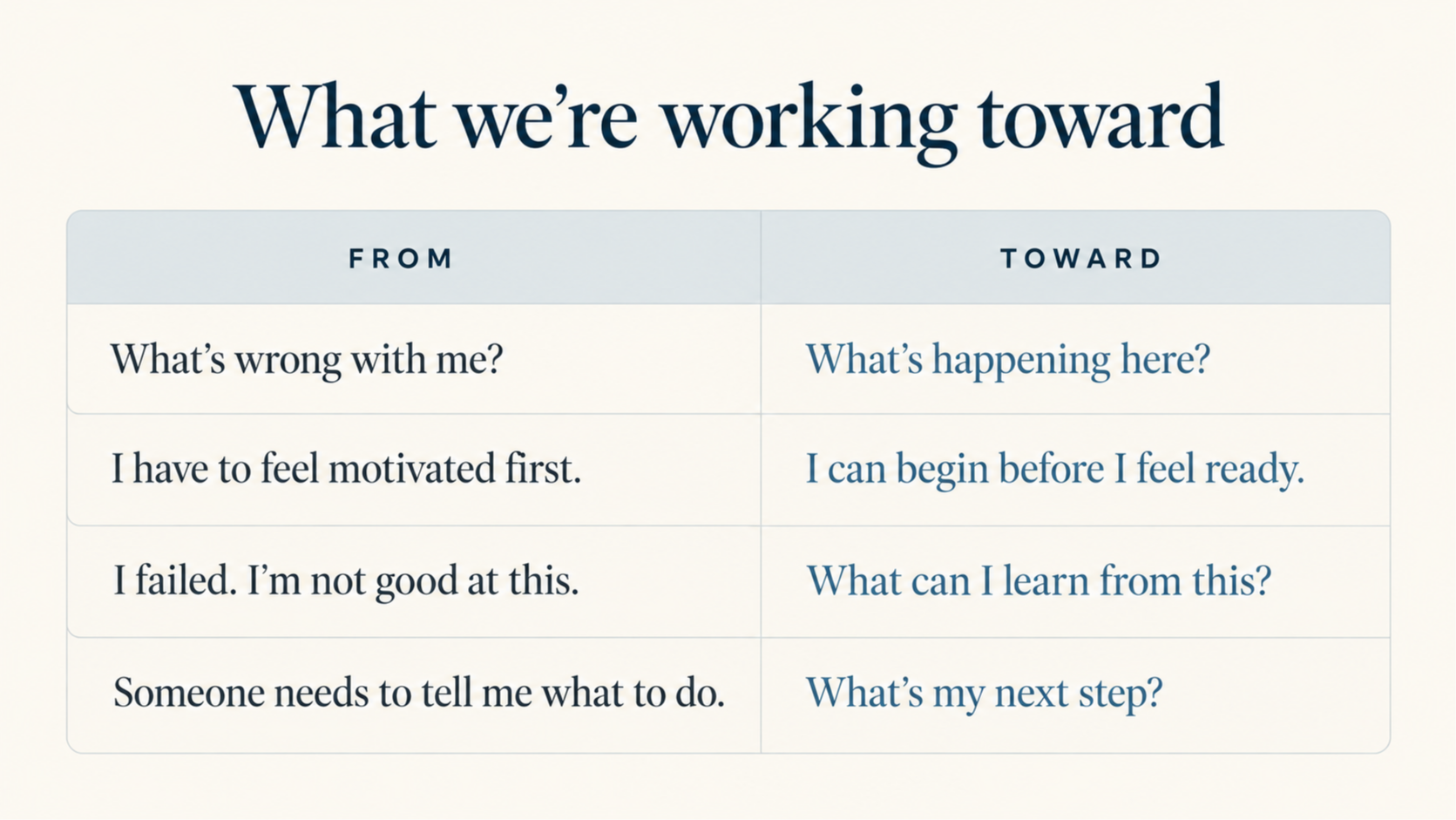
During our workshop, we began looking underneath the behaviors that so often get labeled lazy, unmotivated, distracted, or irresponsible.
We explored what happens when students are overwhelmed, how their patterns develop, and why understanding what's happening is a much more useful starting point than deciding something is wrong with them.
But awareness alone doesn't create lasting change.
A student can recognize that they procrastinate and still procrastinate tomorrow.
They can understand their perfectionism and still feel devastated by a disappointing grade.
They can know they need to ask for help and still find themselves unable to raise their hand.
Because recognizing a pattern and changing a pattern are two different skills.
And that is why I created Student Success Lab.
Twelve weeks to begin building something different.
Student Success Lab is a live, 12-week program designed to help teenagers develop the internal skills that support success in school and beyond.
Not another academic class.
Not another adult telling them to try harder.
Not a program that requires them to arrive motivated, organized, confident, or enthusiastic.
We start with the student who actually shows up.
Over 12 weeks, we work through three essential areas.
First, we learn to see ourselves clearly.
Students begin examining their patterns, expectations, assumptions, and the stories they've developed about themselves.
Why do I react this way?
What am I actually avoiding?
Whose expectations am I trying to meet?
What happens when I stop pretending everything is fine?
We practice self-honesty without turning it into self-criticism.
Then, we learn to think differently.
We explore the voice in their heads, pressure, motivation, comparison, failure, and the beliefs that influence their choices.
Students begin recognizing that a thought isn't necessarily a fact, a feeling isn't an instruction, and a difficult experience doesn't have to become an identity.
Finally, we begin building their future.
We work on decisions, habits, self-advocacy, asking better questions, recovering from mistakes, and understanding the compound effect of everyday choices.
Not because I expect teenagers to have their lives figured out.
Because I want them to develop the confidence that they can figure things out as they go.
And we practice these skills in real life.
This isn't a program where students watch a few videos, fill out a workbook, and are left to figure out how to apply everything.
We meet live each Sunday for our weekly Reset.
Students have a midweek check-in, a workbook, a community, and a personal support channel.
We use the challenges they're actually experiencing in school and life as opportunities to practice what we're learning.
Because the goal isn't for them to understand these ideas while sitting in a workshop.
The goal is for them to begin using them when life gets difficult.
When they don't feel like starting.
When they receive a disappointing grade.
When they're afraid to ask a question.
When they feel behind.
When they don't know what to do next.
That's where this work matters.
Here's what I hope changes for your family.
I hope your student begins recognizing when they're overwhelmed before everything falls apart.
I hope they learn that a bad grade is information, not a verdict on their intelligence.
I hope they begin asking for help instead of silently struggling.
I hope they discover that motivation isn't a prerequisite for action.
I hope they become more comfortable making decisions, trying things, making mistakes, and trying again.
And I hope that, little by little, you find yourself doing less managing and more supporting.
Not because your teenager suddenly becomes perfect.
But because they're developing the skills to take greater ownership of their own life.
That's the transformation we're working toward.
I also want to be clear about what this program isn't.
It isn't a promise that your student's grades will magically improve in 12 weeks.
It isn't a substitute for individualized educational or mental health support when those are needed.
And it isn't a program where I take over the responsibility of managing your teenager.
In fact, quite the opposite.
My goal is to help them become increasingly capable of managing themselves.
Some students will make noticeable changes quickly. Others will need more time, repetition, and support.
That's part of learning.
What I can promise is that I'll bring my experience as an educator, my understanding of adolescent development, and a thoughtfully designed framework to help your student begin practicing skills that matter well beyond their next report card.
So here's my invitation.
Enrollment for Student Success Lab is currently open, and it closes Wednesday, September 30.
If you recognized your child in the workshop...
If you've been reading my emails thinking, This is exactly what we've been dealing with...
If you're tired of the same conversations producing the same results...
Or if your student is doing well academically, but you want them to develop the confidence and independence to navigate whatever comes next...
I'd love to have them join us.
You don't have to wait until things get worse.
And your student doesn't have to be struggling to benefit from learning how to understand and direct themselves.
The goal isn't to build a teenager who performs perfectly when someone is watching.
It's to help them become someone who knows how to navigate life when nobody is standing beside them.
That's the work.
And I would be honored to do it with your student.
With warmth,
Nicole Smith, M.Ed.
Founder, Student Success Lab
Build the person behind the performance.
Ready to take the next step?
Explore the 12-week Student Success Lab program, review the enrollment options, and reserve your student's place.
EXPLORE STUDENT SUCCESS LAB & ENROLL
Enrollment closes September 30, 2026.