
Your Teen’s Brain Isn’t Broken—It’s Still Under Construction
Aug 17, 2026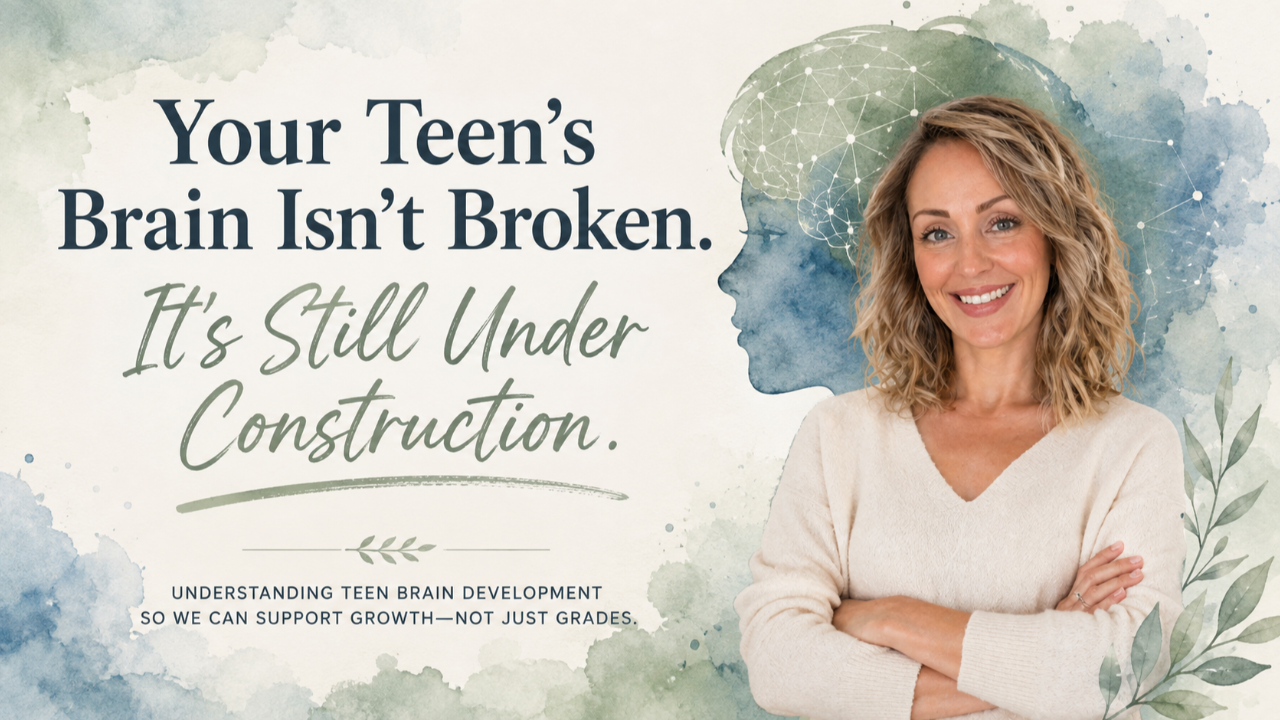
If you’ve ever looked at your teenager and thought:
“What is happening to you?”
You are not alone.
One of the most confusing parts of parenting a teenager is watching a capable, intelligent, once-reliable kid suddenly become inconsistent, emotional, avoidant, or completely unmotivated.
And the natural conclusion many parents reach is:
Something is wrong.
But what if that’s not actually what’s happening?
The teenage brain is not finished yet
During adolescence, the brain is undergoing one of the most significant remodeling periods in human development.
This is not a small update.
It is a full system rebuild.
The parts of the brain responsible for planning, impulse control, emotional regulation, and long-term decision-making are still developing.
Meanwhile, the emotional and reward systems are highly active.
This creates a very real mismatch:
- They can think abstractly
- But struggle to regulate emotions in real time
- They can understand consequences
- But still prioritize short-term relief
- They can care deeply
- But still act in ways that look like they don’t care at all
From the outside, this can look like inconsistency.
From the inside, it often feels like overwhelm.
Why this matters for school behavior
When a teenager procrastinates, avoids work, or shuts down, it is rarely because they “don’t care.”
More often, it is because:
- The task feels too big
- The emotional weight feels too heavy
- They don’t know where to start
- Or starting feels uncomfortable
So their brain does what all human brains are designed to do:
It avoids discomfort.
Not because they are lazy.
Because they are human.
The problem with mislabeling behavior
When we label these behaviors as laziness, irresponsibility, or lack of motivation, we unintentionally create a second problem:
We turn a skill gap into an identity.
“I’m bad at school.”
“I’m just not disciplined.”
“I’m not a motivated person.”
These beliefs are far harder to fix than the original behavior.
A more useful question
Instead of asking:
“How do I get my teenager to try harder?”
We can start asking:
“What is making this feel so hard to start?”
That shift changes everything.
Because now we are no longer trying to fix a “lazy student.”
We are trying to understand a developing brain that needs support building skills like:
- Starting tasks without panic
- Tolerating discomfort
- Breaking down overwhelm
- Recovering from mistakes
- Regulating emotional responses to school stress
These are not personality traits.
They are learnable skills.
The goal is not perfection
The goal is not to raise a teenager who never struggles.
The goal is to raise a young adult who understands themselves well enough to navigate struggle without shutting down.
That is what development actually looks like.
Not smooth.
Not linear.
But very, very human.
Want More Insights Like This?
Join The Student Success Lab Journal and receive thoughtful emails about developing brains, confidence, procrastination, identity, and helping students thrive—in school and in life.
One meaningful email each week. No spam. Just ideas that help students and parents think differently.
We hate SPAM. We will never sell your information, for any reason.
