
Why Students Procrastinate (It's Not Laziness)
Aug 03, 2026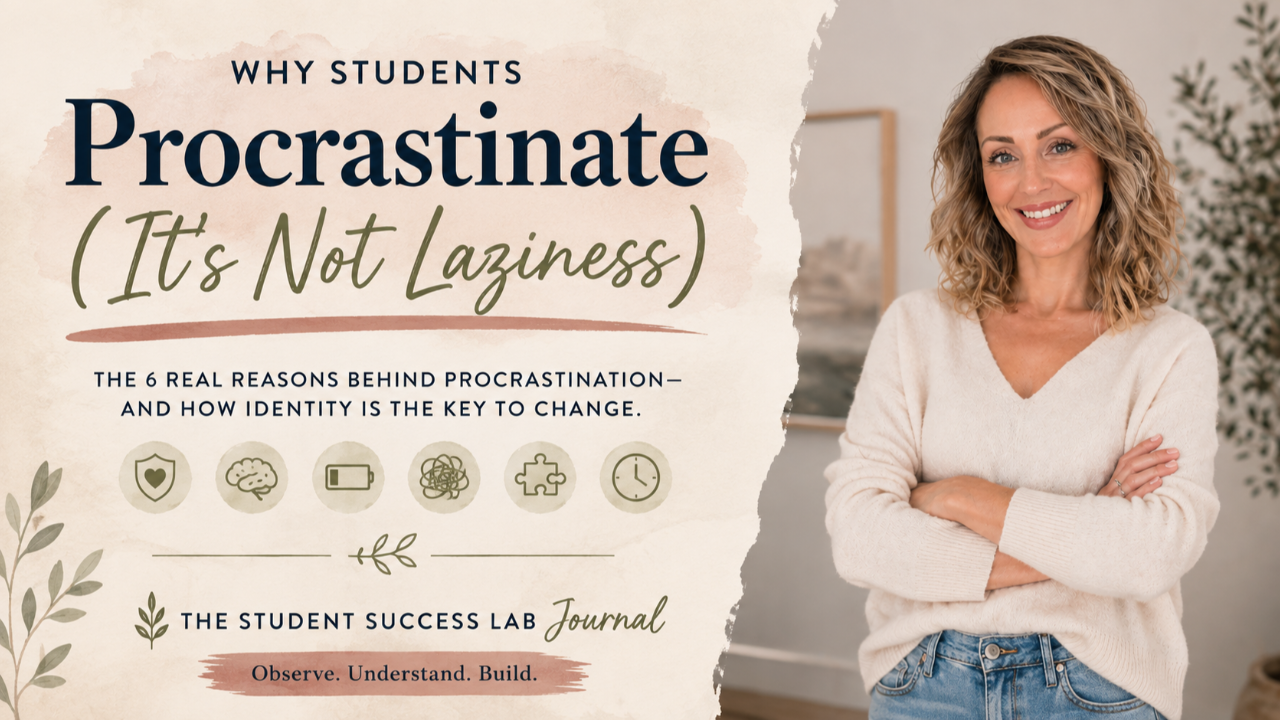
6 Ways Procrastination is Protecting Your Student
"This year is going to be different."
If you're the parent of a middle schooler or teenager, you've probably heard some version of that sentence.
"I'm going to stay caught up this year."
"I'm not going to wait until the last minute anymore."
"I'm going to turn everything in on time."
"I'm really going to study for the SAT this time."
And if you're honest...
A small part of you wants to believe them.
Another part quietly thinks,
"I hope so... but we've been here before."
It's a strange place to be as a parent. You desperately want to trust your child. You know they genuinely believe what they're saying. Yet something tells you that, despite the best intentions, you're probably going to find yourself reminding them about missing assignments, asking if they've started studying, and wondering why everything still seems to happen the night before it's due.
After working with thousands of teenagers over the past fifteen years, I've learned something surprising:
It isn't because they don't care.
And it isn't because they're lazy.
In fact, many of the students who procrastinate the most are also the students who care the most.
They're ambitious.
They're perfectionists.
They're deeply invested in doing well.
Which raises an important question:
If procrastination were simply laziness, why do so many high-achieving, conscientious students struggle with it?
Because procrastination isn't a laziness problem.
It's not even a motivation problem.
It's an identity problem.
That may sound surprising, but stay with me.
For years, we've explained procrastination using the same familiar labels: laziness, irresponsibility, poor discipline, lack of motivation, bad time management, not trying hard enough.
And because we diagnose the problem this way, we prescribe logical solutions.
Buy a planner.
No—a better planner.
Maybe the $50 planner everyone on Instagram swears changed their life.
Wake up earlier.
Be more disciplined.
Stop making excuses.
Just start.
Those strategies aren't bad.
They're just incomplete.
Because if the real obstacle isn't organization...
No planner can solve it.
What's Really Happening?
Modern psychology increasingly understands procrastination as an emotion regulation strategy rather than a time management problem.
But I believe we can go one step further.
The emotion isn't the destination.
It's pointing toward something deeper.
Identity.
Consider one of the most common fears students carry:
Fear of failure.
Students rarely think consciously,
"I'm going to procrastinate so I can protect my self-worth."
Instead, the process is almost entirely subconscious.
If I genuinely try...
If I give this assignment everything I've got...
If I study for weeks...
And I still don't succeed...
What does that say about me?
Suddenly the grade isn't just a grade.
It's evidence.
Evidence that maybe I'm not as smart as everyone thought.
Maybe I don't belong in Honors or AP.
Maybe I'm disappointing my parents.
Maybe everyone was wrong about me.
If those are the stakes, procrastination begins to make perfect psychological sense.
Because if I only studied for an hour...
If I started the night before...
If I "forgot..."
Then there's another explanation available besides I'm not capable.
That's called self-handicapping, and it's one of the brain's ways of protecting a fragile developing identity.
Not because your student is manipulative.
Because they're human.
Six Reasons Students Procrastinate
1. Self-Worth Protection
Adolescence is the season of identity formation.
Teenagers are constantly asking themselves:
Who am I?
Am I capable?
Do I belong?
When success and self-worth become tangled together, procrastination can become a subconscious attempt to protect identity from disappointment.
2. Emotional Avoidance
Homework isn't always difficult.
Sometimes it simply feels unpleasant.
Avoiding it creates temporary relief.
Our brains notice that relief and naturally want to repeat it.
This is why procrastination often feels good in the moment—even though it creates stress later.
3. Decision Fatigue
Students don't just have one job.
They may move through six or seven classrooms every day, each with different teachers, expectations, personalities, grading systems, classmates, and social dynamics.
That's a remarkable amount of mental switching.
Sometimes "I'll do it later" isn't irresponsibility.
It's exhaustion.
4. Overwhelm
When a task feels enormous, the brain often struggles to identify where to begin.
Without a clear entry point, it freezes.
The problem isn't willingness.
The problem is uncertainty.
5. Executive Function Challenges
Students with ADHD, anxiety, or other executive functioning differences often struggle with planning, sequencing, working memory, and task initiation.
These aren't character flaws.
They're neurological differences.
As I often tell students, we all have to bake bread with the flour we've been given.
Success isn't pretending our challenges don't exist.
It's learning how to work with them.
6. Present Bias
Behavioral economics tells us that humans naturally favor immediate rewards over future ones.
The reward for homework might come next week.
The reward from TikTok comes now.
Our brains naturally discount future rewards—even when we intellectually know they're more valuable.
Where I Think We Need to Go Deeper
Modern psychology has made an important shift by recognizing that procrastination regulates emotion.
I agree.
But I don't think that's where the conversation ends.
When I work with students, I ask a different question.
Not:
What emotion are you avoiding?
But:
What identity are you protecting?
Because emotions come and go.
Identity stays.
The assignment isn't the threat.
The grade isn't the threat.
Even failure isn't the threat.
The threat is the story your student believes failure will tell about them.
"Maybe I'm not smart enough."
"Maybe I don't belong here."
"Maybe I'm disappointing everyone."
"Maybe I just got lucky before."
When those are the stories the brain is trying to protect against, procrastination stops looking irrational.
It becomes an understandable—but ultimately unhelpful—attempt to stay emotionally safe.
So What Actually Changes?
It isn't a new planner.
It isn't another productivity app.
It isn't more reminders.
Real change happens when students begin separating who they are from how they performed.
When mistakes become information instead of identity.
When curiosity replaces shame.
When they discover that they are not their grades, their GPA, or their last test score.
That's the work we do inside Student Success Lab.
Because when students build a stronger sense of who they are, they no longer need procrastination to protect them.
They finally feel safe enough to begin.
Want More Insights Like This?
Join The Student Success Lab Journal and receive thoughtful emails about developing brains, confidence, procrastination, identity, and helping students thrive—in school and in life.
One meaningful email each week. No spam. Just ideas that help students and parents think differently.
We hate SPAM. We will never sell your information, for any reason.
