
What Kind of Mind Will Your Child Need in the Age of AI?
Sep 08, 2026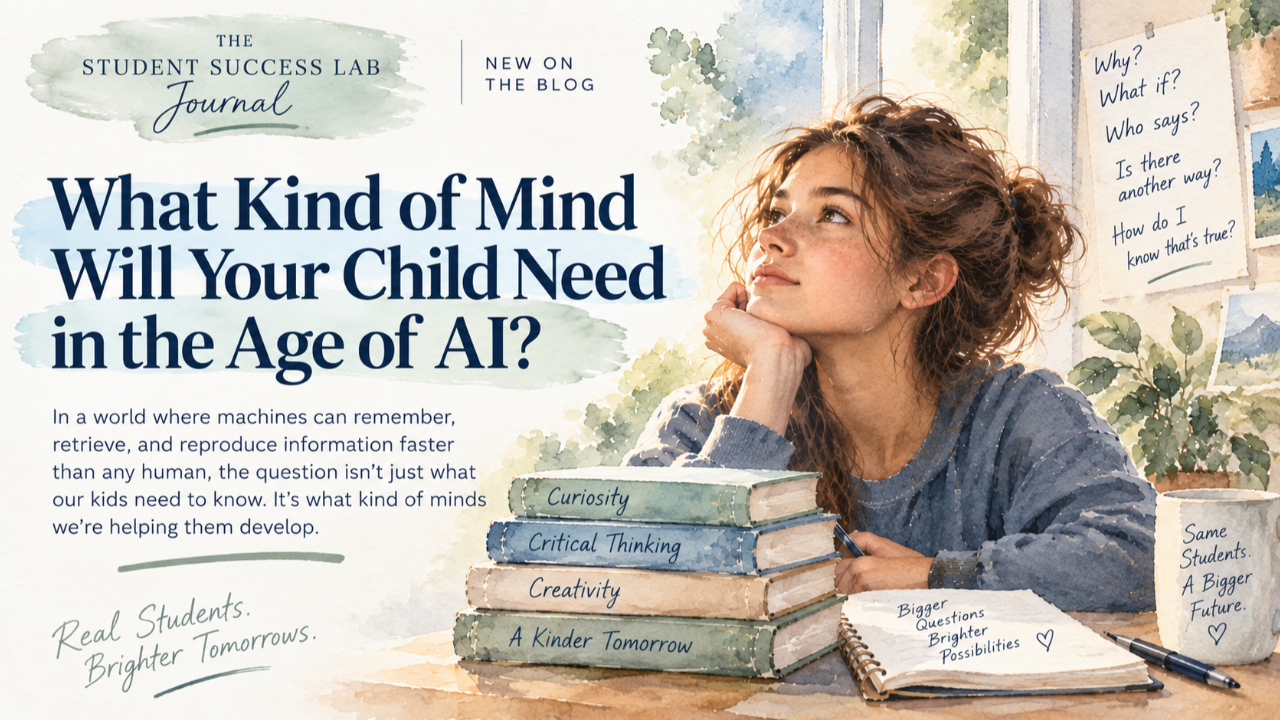
What Kind of Mind Will Your Child Need in the Age of AI?
When I think about education now, I’m increasingly less interested in asking what a child needs to know. In a world where technology is moving faster than our own human thought patterns, even for those who are highly intellectual, being “smarter” isn’t going to get us all that far when AI is moving into the realm of facts and held knowledge faster than Ken Jennings moved in on Jeopardy.
No, the time has come to focus on what separates us from the machines. And for that reason, I am far more interested in asking:
“What kind of mind are we helping our children develop?”
Because our kids are entering a world that looks vastly different from the one our educational system was built for. For generations following the Industrial Revolution, schoolchildren benefited from building many of the tools they needed to succeed in their world: learning information, remembering that information, following instructions to the letter, completing assigned tasks accurately, and producing an expected answer. Along with it, the school system became very good at teaching and measuring those specific things in a loop of:
Learn
↓
Practice
↓
Remember
↓
I’ll tell you when you need it
↓
Show me you know it
This model made a certain amount of sense, albeit standardized, in a world where knowledge was difficult to access and workplaces needed large numbers of people who could reliably follow an established process.
But that isn’t the world our children are entering.
Machines can already retrieve information far faster than any human being. They can summarize it, organize it, analyze data, follow procedures, generate the first draft, perform calculations, and produce the expected answer. And each day, they’re getting better and more accurate at doing it.
So I’m not particularly concerned with whether our kids can become slightly better machines. I’m concerned with whether we’re developing the parts of their minds that machines can’t replace.
Can they think? Not remember. THINK.
Can they encounter information and question it?
Can they recognize when something doesn’t make sense?
Can they hold two competing ideas without immediately needing someone to tell them which one is “right?”
Can they make connections between things nobody told them were connected?
Can they generate an idea instead of waiting to be given one—or selecting one from a list?
Can they look at a problem that doesn’t have an answer key and decide where to begin?
Can they change their mind when new evidence demands it?
Can they tolerate uncertainty?
Can they create, discern, or imagine something that doesn’t exist yet?
Can they communicate their thoughts clearly and compassionately?
Can they ask a better question?
Because THOSE are the skills that are going to separate the brightest minds of tomorrow.
The Best Questions Are Often Inconvenient
This is where I worry about the school system. We’ve inherited an educational structure heavily shaped by standardization. There are standards to cover, curriculum maps to follow, standardized tests to prepare for. There are thirty students in a classroom, fifty-minute periods, and a certain amount of material that needs to be completed before June.
Or before May, if you’re in an AP classroom.
I know that one firsthand. I’m a veteran AP Chemistry teacher who lived that reality for more than a decade, and there simply isn’t enough classroom time to explore every worthwhile question and still cover an entire AP course before the exam. In fact, that’s why I built my first company: to offer the additional support AP STEM students desperately needed to master the material, score highly on their exams, and secure their college credits. It’s still extraordinarily successful, with students consistently outperforming national AP pass rates by 35-40% year to year.
The reality of the limited time a subject-matter teacher has with students is that the student who asks Why? What if? Who says? How do we know that’s true? What happens if we change this? Wait—doesn’t that contradict what you said yesterday? can simultaneously be the most interesting kid in the room and the kid absolutely destroying the lesson plan based on what actually needs to get done to stay on pace.
I know. I’ve taught them. I adore them. But I also had 31 other students sitting there and a unit test on Friday. So eventually, even the most well-intentioned teacher sometimes has to say:
“That’s a great question. We need to keep moving.”
And I think we need to acknowledge what happens when a young person hears some version of that often enough. They learn there isn’t time for curiosity. There is a boundary around the question. There is material we’re supposed to cover and a predetermined place we’re supposed to reach.
And eventually, some students stop asking.
That’s the part I don’t want us to lose.
I Don’t Want to Raise a Kid Who Waits for the Assignment
The future is not going to hand our kids a worksheet. The most interesting problems they’re going to encounter won’t come with:
Directions: Read each question carefully. Show all work.
Nobody is going to tell them which information matters. Nobody is going to guarantee that there is one correct answer. And increasingly, nobody is going to pay them simply because they can do exactly what a machine can do faster.
They’re going to need to notice the problem themselves, question it, determine what they don’t know, find the information, decide whether it’s trustworthy or valid, try something, be wrong, adjust, and try again. They’re going to need to work with people who think differently and, sometimes, create an answer that didn’t exist before they arrived.
That’s an entirely different intellectual skill set from being good at school.
Your child can be exceptional at school without necessarily developing those capacities.
And perhaps more importantly:
Your child can struggle with parts of school while possessing an extraordinary mind.
The kid who questions everything. Who gets bored with repetition. Who wants to understand why before they’ll accept what. Whose brain goes sideways when everyone else’s goes straight. Who sees six possibilities when the assignment asks for one. Who becomes obsessed with something that isn’t on the syllabus. The kid who challenges assumptions. The kid who doesn’t particularly care about earning the point but desperately wants to know whether the idea is true.
Those traits can be inconvenient inside a standardized system. They may be extraordinarily valuable outside of it.
And I’m not interested in romanticizing every unfinished assignment as evidence of hidden genius. Sometimes an unfinished assignment is just an unfinished assignment.
Our kids still need to learn follow-through and discipline, and of course they need foundational knowledge. They need to learn how to operate inside systems, even systems they would not personally design. But what I don’t want is for them to become so good at following directions that they lose the ability to determine their own direction, their own values, and their own path.
And when teachers and administrators are reporting profound levels of student apathy, I think we should at least be willing to ask whether we've overcorrected toward compliance at the expense of ownership. If students spend years being told what to learn, when to learn it, how to demonstrate it, and what constitutes success, we shouldn't be entirely surprised when some of them stop feeling like active participants in their own education.
I’m interested in balance: learn how to play the School Game, but don’t confuse being good at the game with developing your MIND.
Education Should Develop a Mind, Not Just Fill One
Maybe that’s the distinction I’ve been trying to articulate after more than 15 years educating students. School, as a matter of necessity, asks, “What should every student know?” But education should also ask, “What could this particular mind become?”
Both are worthwhile questions.
But they are not the same question.
I want a student who can learn the material—and question it.
A student who can follow directions—and recognize when a different direction might be better.
A student who can find the “right” answer—and ask the question nobody else thought to ask.
A student who can succeed inside a system—and think independently of it.
The world our children are inheriting doesn’t need another generation of young people who are exceptionally good at waiting to be told what to do and how to do it.
It needs people who can figure out what ought to be done next—and then figure out how to do it.
And that is a very different kind of education.
This Is Exactly Why I Created the Student Success Reset
The Student Success Reset is a free live workshop for students who are capable of more—but may be getting stuck in procrastination, overwhelm, perfectionism, self-doubt, lack of motivation, or simply not knowing how to work with themselves yet.
We’ll step outside the grades and assignments for a moment and look at the student underneath them.
Want More Insights Like This?
Join The Student Success Lab Journal and receive thoughtful emails about developing brains, confidence, procrastination, identity, and helping students thrive—in school and in life.
One meaningful email each week. No spam. Just ideas that help students and parents think differently.
We hate SPAM. We will never sell your information, for any reason.
