
Part 3: The Goal Isn’t a Motivated Student. It’s a Self-Directed One.
Sep 03, 2026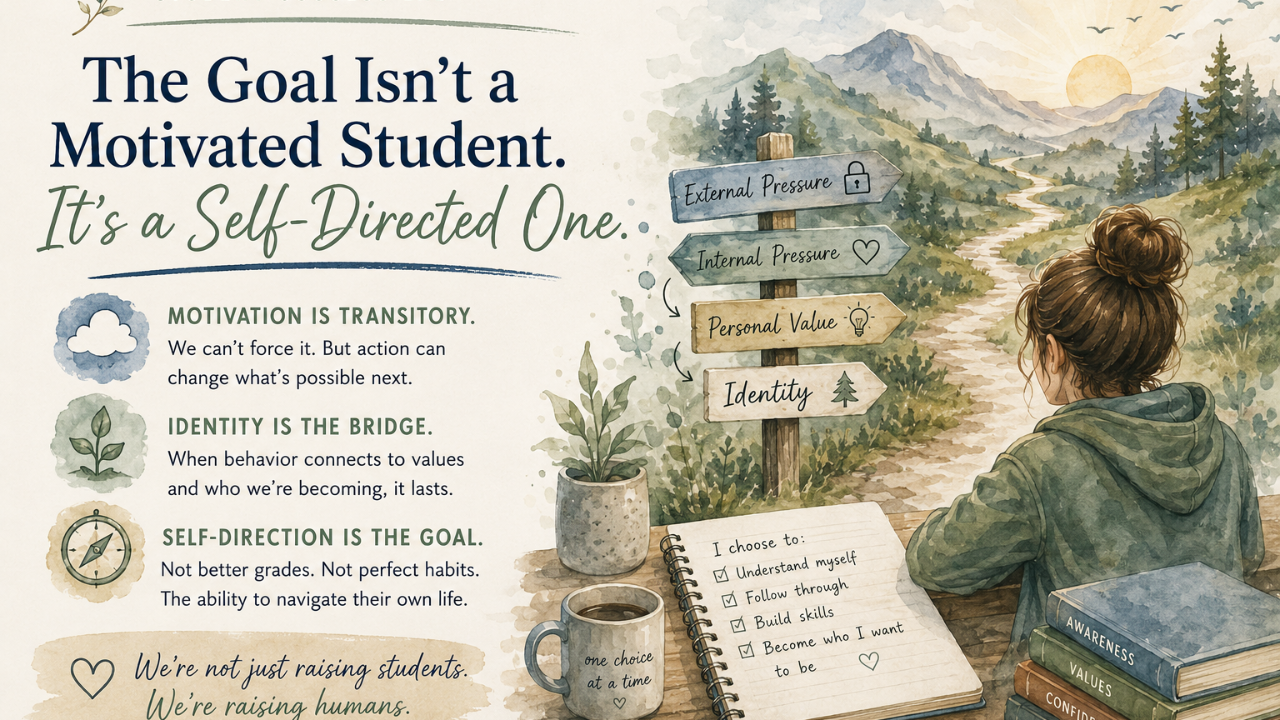
At this point, we know that motivation is transitory. We can’t force it for ourselves, and we certainly can’t force it for someone else. We know that beginning can change the motivational landscape—that sometimes ten minutes is enough to get the ball rolling, and we continue either because we genuinely get into the swing of things or because, well, we’re already here. We might as well finish.
And as parents or otherwise caring adults, we know that we can probably make our students uncomfortable enough to spur them into action. We can take their devices. We can take their driving privileges. Heck, we can take the door off their bedroom.
And some of those consequences may even work.
But eventually, we have to face the fact that we’re not always going to be there to remind, nag, check the online grade portal, or manufacture enough discomfort to make them move.
The real question we ought to be asking is:
What happens when nobody is standing over them anymore?
Parents can remind. Teachers can impose deadlines and penalties for late work. Tutors can provide accountability. Schools can create consequences. Apps can send notifications. Planners can beep.
But eventually, the student leaves.
College. Relationships. Work. Money. Health. Life.
And many of the external structures that have supported—or pressured—them up to this point begin to fall away.
So while we tend to get caught up in the granular, everyday goal of “get the teenager to complete the assignment,” the larger goal, for their sake and ours, has to become:
Help the teenager build the internal structures they’ll need to direct themselves.
And this is where identity becomes the bridge.
A student doesn’t need to think, “I love studying!” or “I love doing my absolute best on subjects I find boring and irrelevant!” They can think:
“I am someone who follows through.”
They don’t need to wake up thinking, “I’m incredibly motivated to go to practice today!” Far more useful is:
“Being an athlete means I practice on days I don’t particularly feel like practicing.”
They don’t need to think, “I desperately want to revise this essay.” They can think:
“I care about becoming someone who does work I’m proud to put my name on.”
Now the behavior is no longer governed solely by whatever emotion happens to be loudest in that moment. It has become connected to values and identity. And that's a much more durable source of direction.
The Bridge We’re Actually Trying to Build
Ideally, we are helping students move from:
“My mom will take my phone if I don’t.”
External pressure
↓
“I’ll feel terrible about myself if I don’t.”
Internal pressure
↓
“I understand why this matters.”
Personal value
↓
“This is connected to the person I’m choosing to become.”
Identity
That distinction matters because simply moving the pressure inside the student isn't really the goal either. A teenager who no longer needs Mom standing over them because they've learned to stand over themselves with shame, fear, perfectionism, and self-criticism may look more independent from the outside. But that's not the kind of independence we're trying to build.
Self-direction isn't learning how to become your own taskmaster.
It's developing enough self-awareness, personal values, skills, and agency to choose your behavior even when your feelings are pulling you somewhere else.
“I Don’t Want To” Can Be True
This is one of the things I most want students to understand. Two things can be true at once.
Present me: I really don't want to do this.
Future me: I would really like to have this done.
Neither voice has to be wrong.
The question becomes:
Agentic me: Both of those things are true. So what am I choosing?
That's an entirely different internal conversation from:
“Ugh. Why am I so lazy?”
One conversation is an identity judgment. The other is a decision, and decisions can be practiced.
A self-directed student isn't a teenager who never procrastinates, never gets overwhelmed, always makes the best choice, loves school, has perfect habits, and cheerfully completes every assignment three days early. That teenager does not exist.
A self-directed student is increasingly able to notice:
This is what I'm feeling.
This is what I want right now.
This is what I want later.
This is what matters to me.
This is the person I'm trying to become.
So what am I going to choose?
That is agency. And that's why, after fifteen years of working with students, I'm increasingly less interested in the question:
“How do we make teenagers more motivated?”
I'm much more interested in:
“How do we help them become people who can direct themselves?”
Because eventually, we won't be standing beside them reminding them what comes next. The goal is for them to know how to figure that out.
Want to Help Your Student Start Building This?
This is exactly the work we're beginning inside the Student Success Reset, my free live workshop for students on September 19, 2026. Parents are welcome, too.
We'll look underneath procrastination, overwhelm, perfectionism, motivation, and the patterns that keep students stuck—not to give them another lecture about what they should be doing, but to help them understand themselves well enough to begin doing something different.
Because the goal isn't simply better grades.
It's helping your student become someone who knows how to navigate their own life.
Sign Up to be notified about the next free Student Success Reset → [link]
Want More Insights Like This?
Join The Student Success Lab Journal and receive thoughtful emails about developing brains, confidence, procrastination, identity, and helping students thrive—in school and in life.
One meaningful email each week. No spam. Just ideas that help students and parents think differently.
We hate SPAM. We will never sell your information, for any reason.
