
Part 2: The Motivation Myth: You Don't Have To Feel Like It To Begin
Aug 26, 2026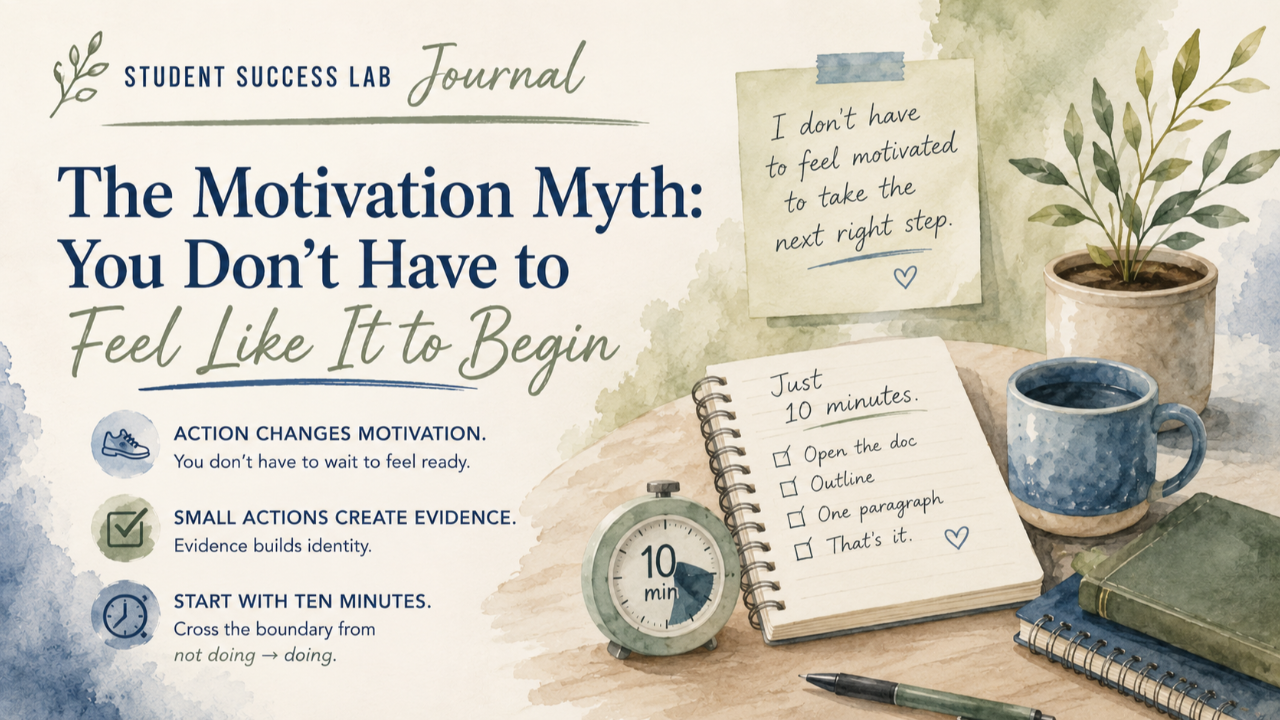
The Motivation Myth: You Don't Have to Feel Like It to Begin
If you haven’t read Part 1, go back and do it now. There is a reason that this is difficult. We talked about what motivation actually is, what competes for it, and the conditions that make self-directed motivation more—or less—likely to grow.
Now we’re going to move into the next phase:
Difficulty doesn’t get to make every decision.
There’s a premise I hear from students all the time: they’ll “do the thing” when they “feel motivated to do it,” as though motivation is going to magically appear one afternoon and make precalculus homework sound like a wonderful way to spend an evening.
To be fair, adults do this too.
“I’ll start exercising when I feel motivated.”
“I’ll clean out the closets when I feel like it.”
For our students, it might sound like:
“I’ll start studying when I feel motivated.”
“I’ll clean my room when I feel like doing it.”
“I’ll work on my college applications when I’m in the right headspace.”
Here’s the misconception: motivation does not have to come first.
Sometimes it does. Sometimes we get excited about something, that excitement propels us into action, and off we go. But action itself can also change the motivational landscape.
How many times have you thought, “I’ll just put these dishes from the sink into the dishwasher,” but then you’re already there, so you might as well wipe down the counters, and twenty minutes later the kitchen is sparkling?
You didn’t necessarily become deeply passionate about cleaning your kitchen. You started. And once you were already in action, continuing didn’t seem like nearly as big a deal.
Beginning reduces ambiguity. Progress can increase our sense of competence. Competence can make further engagement easier. The task we were imagining from the couch becomes the task we are actually doing—and those are often two very different things.
Action alters the conditions that influence what we feel capable of doing next.
The framework we think we need is:
Feel motivated → Do the work → Become successful
But another pathway is available to us:
Do something small → Experience yourself doing it → Accumulate evidence about who you are becoming
That last step matters, because this isn’t just about productivity.
It’s about identity.
When a student begins to see themselves as the kind of person who practices precalculus each night, something interesting happens. By practicing precalculus each night, they accumulate evidence that they are the kind of person who does that. The kind of person who keeps commitments to themselves. The kind of person who can do difficult things without waiting to feel like doing them. The kind of person who is capable of becoming someone they’re proud of.
Behavior becomes evidence.
And evidence helps build identity.
What If We Stopped Making the Decision Every Day?
This brings me to an idea I love from Seth Godin: the practice.
A practice is something we decide to do regularly. And one of the beautiful things about developing a practice is that we don't have to make the original decision over and over and over again.
I have a practice of waking up in the morning and exercising before I do anything else. I don't wake up every morning, lie in bed, and begin negotiations with myself about whether I feel sufficiently motivated to lift weights that day.
I already made that decision.
My job that morning is simply to follow through on the commitment I made to myself. I can show up enthusiastic. I can show up annoyed. I can show up tired. I can complain internally for the first ten minutes if I really want to.
But my feelings don't get to remake the decision every morning.
And every time I follow through, I collect another little piece of evidence:
I am the type of person who keeps commitments to themselves.
Feeling motivated had very little to do with getting the job done.
That's the lesson I want students to understand:
Motivation doesn’t have to precede action.
Once we remove the misconception that we have to feel like doing something before we can begin, we have an entirely different set of circumstances in front of us.
And I don't want to promise students that if they just start, they'll suddenly feel motivated. You know as well as I do that you can start your taxes, continue doing your taxes, finish your taxes, and never once experience a passionate desire to do your taxes.
That's okay.
The skill we're trying to develop isn't:
I can make myself want to do everything.
It's:
I am capable of acting before my feelings give me permission.
That changes the question from:
“Do I feel like studying tonight?”
to:
“What do I do when it’s time to study?”
That's how we begin building a practice.
Start With Ten Minutes
So how can you begin practicing this at home with your student?
Ten minutes.
Our brains are pretty okay with sitting down for a short period of time to do something we don't necessarily want to do when we know we only have to withstand it for ten minutes.
This isn't magic. Ten minutes doesn't trick the brain into suddenly loving homework. It's useful because it changes the size of the perceived commitment.
Compare:
“I need to write an entire essay, find and cite my sources, edit it, and somehow produce a final draft worthy of a 5.”
with:
“I need to work on my essay for ten minutes.”
The second one creates an entry point.
After ten minutes, the student has already crossed what may have been the hardest psychological boundary:
Not doing → Doing
And now they have new information.
Maybe they continue. In my years working with students, I've seen this happen innumerable times: a student fiercely resists starting something, finally begins, and then keeps going because they're in the swing of it, the task isn't quite as terrible as they imagined, or they reach the point of, “Well, I might as well just finish it now.”
Maybe motivation follows.
Maybe it doesn't.
Maybe they stop after ten minutes.
But either way, they practiced beginning.
And that's the part I don't want us to miss.
If a student practices ten minutes because we secretly hope they'll work for an hour, we're still measuring success by whether they finished the assignment.
But the skill we're trying to build here is different.
We're teaching their brain:
I can feel resistance and begin anyway.
I can feel overwhelmed and make the task smaller.
I don't have to wait for the perfect emotional state.
I can keep a commitment to myself.
Every time they practice beginning, they're collecting evidence about who they are capable of becoming.
And eventually, “I can begin even when I don't feel like it” becomes far more useful than waiting around to become a person who is magically motivated all the time.
Want More Insights Like This?
Join The Student Success Lab Journal and receive thoughtful emails about developing brains, confidence, procrastination, identity, and helping students thrive—in school and in life.
One meaningful email each week. No spam. Just ideas that help students and parents think differently.
We hate SPAM. We will never sell your information, for any reason.
